




LABOGenetics XXL Cat
- Home
- LABOGenetics XXL Cat
The large-scale genetic screening for your cat – at LABOGEN for only 109 €*.
Product overview
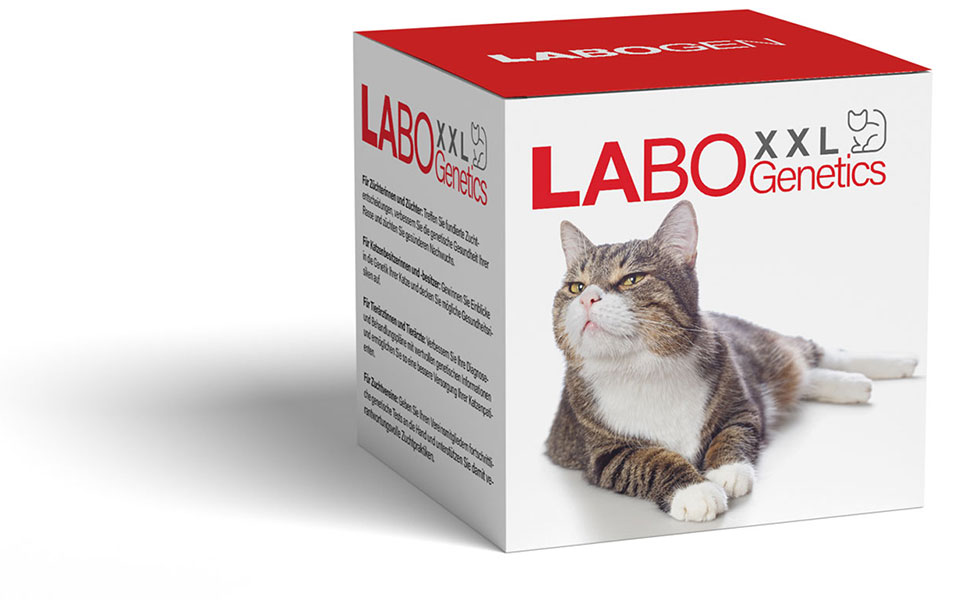
Would you like to know more about your cat’s genetics? New as of July 1, 2026: The LABOGenetics XXL Cat Package now includes analysis of over 100 genetic variants. You will receive information on hereditary diseases, genetic risk factors, coat colours and coat characteristics. The determination of the genetic blood group is, of course, also included. LABOGenetics XXL Cat is available for cats of all breeds and mixes.
LABOGenetics XXL Cat is of interest to everyone, whether you are a cat owner, breeder or veterinarian.
- For breeders: Make informed breeding decisions, improve your breed’s genetic health and ensure that healthier kittens are born.
- For cat owners: Gain insight into your cat’s genetics and learn about possible genetic health risks.
- For veterinarians: Improve your diagnosis and treatment options by incorporating valuable genetic information to determine the best care for your patients.
- For breeding clubs: Offer your club members state-of-the-art genetic testing and support responsible breeding practices.
General questions
- Comprehensive testing: We provide detailed results for all tests, so you will know whether your cat carries predispositions for any of the included genetic diseases. Moreover, coat colour and trait tests, as well as the genetic blood group determination are also included.
- Universal applicability: The package is recommended for cats of all breeds and for mixes with unknown genetic background, as it contains both breed-specific and cross-breed tests.
- Bonus information: Even if you are primarily interested in specific genetic tests, you will gain additional relevant genetic information by choosing this package.
- Support science: With your purchase you will support the scientific research on the genetic health of our animal companions. The screening process can also identify possible variants for hereditary diseases and coat traits that were previously unknown in a particular breed.
A conventional single test is particularly suitable for rapid targeted diagnosis in the case of a symptomatic animal, or if certain hereditary diseases have to be excluded in a very short time. The single tests can usually be finished faster than packages or screenings, but are comparatively more costly.
If you want to get an overview of your cat’s genetic status, our new LABOGenetics XXL Cat package offers a comprehensive, inexpensive screening. The package is suitable for owners, breeders and veterinarians and also provides useful information for breeding associations that can contribute to the health of our cats. The regular turnaround time is 10-14 business days after arrival of the sample in the lab.
In your test report, results are structured for you to immediately see which tests are most relevant for your cat’s breed. These are listed in the section ‘breed specific variants’. All other results are provided under ‘breed non-specific variants’. This structure allows you to easily identify the most important findings for your cat while still ensuring that variants associated with rare or less well-characterized hereditary diseases are not overlooked.
The screening in addition includes genetic variants for which breed-specific frequencies are still under investigation. Although these variants are not yet fully characterized across all breeds, they have already been associated with disease and may therefore provide relevant information about your cat’s genetic health. Their clinical significance, that is, whether and how a cat develops clinical signs, can vary between breeds and is continuously reassessed as new scientific evidence becomes available.
The package is recommended for cats of all breeds and for mixes with unknown genetic background, as it contains both breed-specific and cross-breed tests.
Mixed-breed cats can also be carriers of genetic diseases and show symptoms, so that appropriate precautions for the life of the cat or targeted breeding decisions may be necessary.
For all breed cats, the breed-specific test results are indicated first in the test report, as they are especially relevant to the particular breed. Then, all further analyzed test results are listed. This helps you to identify the tests that are particularly relevant to your cat, without overlooking possible variants of rare or previously unknown genetic diseases in the breed.
We strongly recommend submitting an EDTA blood sample as blood contains up to 100 times the amount of DNA compared to a buccal swab. Alternatively, you can request specially optimized swabs when you place your order. If a cheek swab is taken correctly, the desired results can also be obtained. Please only use the specially optimized swabs and not the swabs from our standard test kit.
You will typically receive the results of the LABOGenetics XXL cat package within 10-14 business days due to the extensive testing.
Tip: If you want quicker insights, check out our large selection of individual tests. These can often be offered with a significantly shorter examination time.
In rare cases, not all test results can be obtained. Such results are marked as “not evaluable”. In most cases, this is due to insufficient quality or quantity of the DNA, that we isolated from the submitted sample. However, previously unknown mutations can also be the underlying cause. We guarantee results for at least 95% of all tests included in the package. If you have any questions please contact labogen@laboklin.com.
Hybrid cats are breeds that originated from crosses between domestic cats and wild cat species (e.g. Bengal, Savannah, or Chausie). Due to the genetic influence of the wild cat species, special features may occur in their genome, such as altered DNA sequences, duplications, or other structural variants. LABOGenetics XXL Cat has been successfully tested on examples of such hybrid breeds. However, as hybrid cats can be genetically very diverse, it cannot be completely ruled out that in very rare cases certain markers may not be fully detected in individual animals if their genomic structure differs from that of domestic cats at the tested loci. Nevertheless, LABOGenetics XXL Cat provides valuable information for hybrid cats as well, offering helpful guidance on potential inherited diseases and traits.
Which tests are included in the LABOGenetics XXL Cat package?
110 tests displayed