Please note: We require either 0.5 – 1.0 ml EDTA blood or a specially optimized swab as sample material, not the cheek swabs of our standard test kit.
DLA genes encode proteins that play a central role in the dog’s immune response by presenting antigens on cell surfaces, thus enabling the immune system to recognize self and foreign structures. As part of the MHC complex, they are inherited in fixed combinations (haplotypes). A high level of genetic diversity among these genes enhances immune responses. As part of the MHC complex, they are inherited in fixed combinations (haplotypes). A high level of genetic diversity among these genes enhances immune responses.
DLA genes (Dog Leukocyte Antigens) encode proteins that play a central role in the dog’s immune response. They belong to the MHC complex (major histocompatibility complex) class II, which play a role in recognizing foreign substances and present them to the immune system to trigger a targeted defense response. It is essential for the immune system to distinguish between the body’s own cells and foreign cells, such as bacteria or viruses. Any errors in this recognition process can lead to autoimmune diseases.
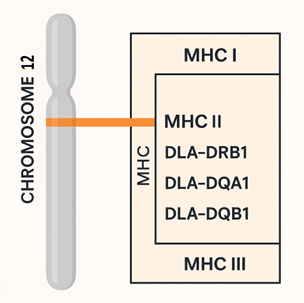
In dogs, the MHC complex is located on chromosome 12. The DLA genes located in the class II region are particularly important for breeders and veterinarians, as they regulate the humoral (antibody-mediated) immune response.
The three most important DLA genes analysed in dog breeding are:
– DLA-DRB1
– DLA-DQA1
– DLA-DQB1
These genes are inherited as a haplotype — meaning, as a fixed combination passed down from one parent to the offspring.
A high diversity of DLA genes contributes to a stable and functioning immune system. The greater the genetic diversity, the better the immune system can respond to a wide variety of pathogens.
In many dog breeds, selective breeding has led to a reduction in this diversity, leaving only a small number of possible haplotypes. Factors such as a limited breeding pool, the use of popular sires, and the repeated mating of related dogs can severely reduce genetic diversity.
Breeding goal: Maintain or increase DLA diversity within the breed.
Homozygosity vs. Heterozygosity
Homozygous: two identical alleles of a gene
Heterozygous: two different alleles of a gene
A heterozygous dog therefore has greater genetic diversity in the MHC complex than a homozygous dog.
An autoimmune component is being discussed for the development of diseases such as diabetes mellitus, exocrine pancreatic insufficiency, hypothyroidism, and Addison’s disease. Scientific studies have linked certain DLA haplotypes to increased or decreased risks of autoimmune diseases. Important notes:
Examples of protective alleles
| DLA-DRB1 | DLA-DQA1 | DLA-DQB1 | Reduced risk |
|---|---|---|---|
| 015:01 | 006:01 | 020:02 | Diabetes mellitus |
| 018:01 | 001:01 | 008:02 | Hypothyroidism |
| 018:01 | 001:01 | 002:01 | Addison’s disease |
Examples of risk alleles
| DLA-DRB1 | DLA-DQA1 | DLA-DQB1 | Increased risk |
|---|---|---|---|
| 020:01 | 004:01 | 013:03 | Diabetes mellitus |
| 001:01 | 001:01 | 002:01 | Hypothyroidism |
| 001:01 | 002:01 | 013:03 | Addison’s disease |
An Example:
The English Cocker Spaniel “Henri” has the gene combination DRB1 001:01 – DQA1 002:01 – DQB1 013:03, which is associated with an increased risk for Addison’s disease. As a precaution it is recommended to have an annual check-up at the vet, including a blood test (e.g. Addison’s profile).
DLA typing determines the alleles present in a dog. This is done via sequencing in a laboratory, followed by bioinformatic analysis.
Target groups for typing:
What does the typing show?
✅ Listing of individual alleles of the genes DLA-DRB1, DLA-DQA1, and DLA-DQB1 (e.g., DRB1*015:01, DQA1*001:01)
✅ Indication of increased or reduced risk of disease, if known for the breed
❌ No direct detection of diseases
DLA genes are a tool in assessing the genetic diversity of a dog’s immune system. Through targeted DLA typing, breeders can act responsibly and reduce health risks in their own offspring and within the population on a long-term basis.